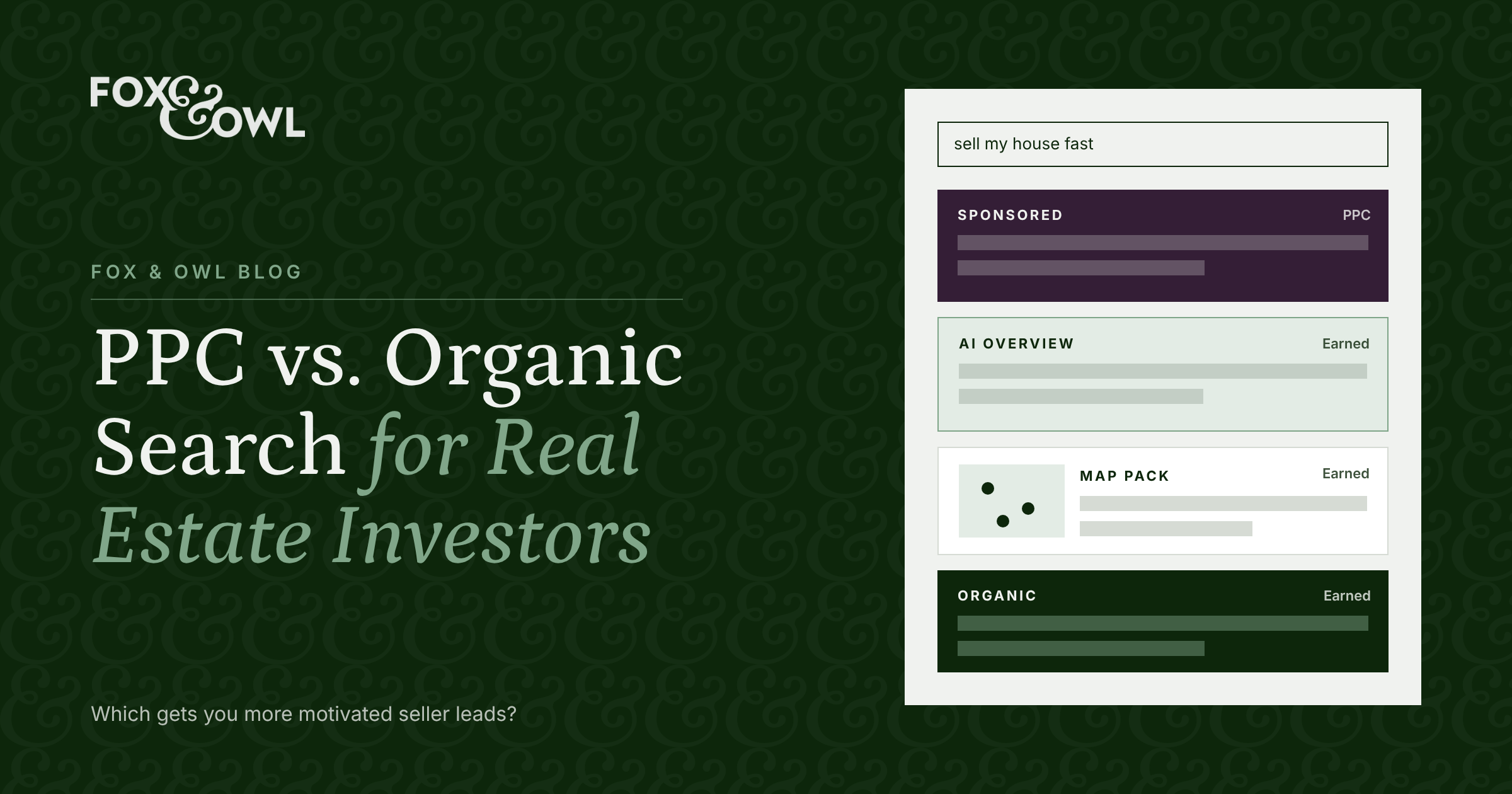
Every motivated seller in your market who types “sell my house fast” into Google Search sees two kinds of results: the ones investors pay for and the ones investors earn. Real estate investors who scale learn to use both, on purpose, in the right order.
We manage SEO and Google Ads for cash home buyers, wholesalers, and multi-market operators across the country. This guide covers how PPC and organic search actually compare for motivated seller leads, what each one takes to work, and how to decide where your next dollar goes.
The Quick Answer
PPC buys speed and control. Organic search builds an asset that keeps producing leads after the work is done. Most investors should run PPC while their organic system matures, then shift budget toward organic lead generation as it starts carrying more of the load.
What does organic search mean?
Organic search means the unpaid results Google shows below the ads and the map. You earn these placements by having pages that search engine bots can access, understand, and trust as the best answer to a searcher’s question. You do not pay per click, but you do invest in your website, content, local presence, and reputation.
For real estate investors, organic search shows up as location-specific landing pages (“sell my house fast in Tulsa”), situation-specific pages (inherited homes, foreclosure, tenant-occupied properties), helpful articles, and your Google Business Profile in the local map results.
What is PPC?
PPC (pay-per-click) is paid advertising where you pay each time someone clicks your ad. For investors, PPC usually means search ads in a Google Ads account: you choose the keywords, the target location, a daily budget, and the ad copy, and your ad can appear at the top of Google Search for those searches.
The tradeoff is simple. PPC visibility starts quickly and stops the day your budget stops. Organic visibility takes longer to build and keeps working when you are not paying for every click.
What a motivated seller sees on Google Search
Search “sell my house fast [your city]” on your phone and you will usually see four layers:
- Search ads at the top, marked “Sponsored.” This is PPC.
- An AI Overview on many searches, where Google summarizes an answer and cites the sources it trusts.
- Local map results (the map pack), powered by Google Business Profiles and Google reviews.
- Organic results, the traditional listings, where your location and situation pages compete.
Sellers trust what they see more than once. An investor who appears in the ads, the map pack, and the organic results earns credibility before the seller ever clicks. That is why the strongest acquisition strategies do not pick a side.
PPC vs. organic search: the differences that affect your deals
PPC | Organic search | |
|---|---|---|
Speed to first lead | Days to weeks after launch | Usually months, faster in less competitive markets |
Cost structure | Ongoing media spend plus management | Front-loaded investment in content, technical SEO and authority |
When you stop paying | Leads stop | Visibility continues, then slowly fades without upkeep |
Control | High: you pick keywords, budget, location settings and ad copy | Lower: rankings shift with competitors and algorithmic changes |
Seller trust | Some sellers skip ads | Strong; organic and map results carry built-in credibility |
Best use | Testing markets, filling gaps, near-term deals | Long-term cost efficiency and brand awareness |
Speed. A new Google Ads campaign can produce calls within days of approval. Organic search takes longer because Google needs to crawl, index and trust your pages. Plan on months, not weeks.
Cost. PPC is a rent payment: you pay for every click, every month. Organic search is closer to a mortgage: a front-loaded investment in your site and content that lowers your cost-per-lead over time. Organic traffic is not free; it costs time and money up front instead of per click.
Lead quality. Both channels produce motivated seller leads. Paid leads often arrive faster and are frequently shopping several buyers. Organic leads have usually read your pages first, so they tend to arrive with more trust. Your CRM data is the real judge here, not general rules.
Control. PPC gives you a dial: raise the daily budget, pause a keyword, change the ad. Organic search gives you an asset you influence but never fully control.
Where AI search fits in
Sellers now ask Google’s AI Overviews and tools like ChatGPT questions like “who buys houses for cash in Tulsa?” These tools name a few businesses they trust and cite the sources behind their answer.
We call this the Citation Economy. “Citation” now means two things at once: the local business listings Google uses to verify you, and the sources AI platforms cite when they answer a seller’s question. You can buy an ad near an AI answer, but you cannot buy a place inside it. Being cited is earned through the same organic system that drives rankings: clear pages, consistent business information, Google reviews, and mentions from trusted sites.
We see this working for our clients. One of our investor clients now appears ahead of Zillow across major AI platforms for seller questions in his market.
Learn how we help investors show up in AI answers with AI search optimization.
What PPC takes to work for real estate investors
You do not need to run Google Ads yourself, but you should know what a well-run account looks like. Use this section to evaluate your own campaigns or the agency running them, including our PPC management.
Account structure built on search intent. A strong Google Ads campaign groups keywords into tight ad groups by search intent: one for “sell my house fast [city],” another for inherited properties, another for foreclosure. Keyword research with tools like Google Ads Keyword Planner shows search volume, but intent-based phrases from real seller pain points matter more than raw volume.
Match types and negative keywords. Broad match reaches related searches you never chose, phrase match stays closer to your wording, and exact match targets searches with the same meaning. Every investor account needs a growing list of negative keywords (“rent,” “jobs,” “realtor,” “how to wholesale”) to stop irrelevant clicks from draining the budget.
Ads that earn the click. Responsive search ads let you supply up to 15 headlines and 4 descriptions, and Google tests the combinations. Pinning headlines and descriptions keeps key messages in place but limits that testing, so pin only what must always show. Your ad copy should state your unique selling proposition (USP) plainly: a fast, flexible closing date, buying as-is, and no commissions. The Display URL should match the page the seller lands on.
Assets (formerly called ad extensions). Sitelinks, Call-Outs, Structured Snippets, call assets with your phone number, image assets (formerly image extensions), and location assets linked to your Google Business Profile all make your ad larger and more useful. They are free to add and often improve click-through rate (CTR).
How the auction works. Your bid is only part of the equation. Google uses Ad Rank, which weighs your bid with ad quality, expected CTR, and landing page experience. Quality Score (1 to 10) is a diagnostic for that quality; a higher score can lower your cost-per-click (CPC) for the same position.
Bidding strategy. Manual CPC (manual bidding) gives you direct control over each bid. Automated bidding uses machine learning: Maximize Clicks chases traffic, Maximize Conversions chases leads, Target CPA (cost-per-lead bidding) aims for a set cost per lead, and target impression share bidding chases visibility. You can set a Maximum Cost-per-Click (CPC) limit on some strategies. Every automated strategy has data dependence: it only works as well as your conversion tracking and conversion data. Feed it junk form fills and it will find you more junk.
Landing page alignment. An ad about inherited houses should land on an inherited-house page, not the homepage. That page needs a mobile-friendly layout, a short lead capture form, a visible phone number, credibility badges and reviews, an accurate business description, a privacy page, and one clear call to action (CTA). Use A/B testing to compare one change at a time, such as a short form against a longer qualification form.
Budget and targeting. Set a testing budget before you scale, then a monthly budget once you know what a lead and a deal cost. Check location settings so you reach people in your target location, not only people interested in it, and focus campaigns on the property type and seller situations that fit your customer avatar. Google restricts audience targeting options for housing-related ads in the US, so build campaigns around search intent and location rather than demographics.
Remarketing and video. Remarketing shows ads to past visitors, within Google’s housing-ad restrictions and your privacy obligations. YouTube Video Ads can build brand awareness cheaply in a market, but treat video views as awareness, not leads.
The risks. Account suspension, policy changes, and rising CPC can interrupt lead flow overnight. That is the strongest argument for channel diversity: never let one ad account be your only source of deals.
What organic search takes to work for real estate investors
Organic lead generation works when you build an organic system, not a pile of pages. Here is what that system includes.
Start with an audit of your current organic presence. Confirm your important pages are crawled and indexed, find broken pages and redirect chains, and check Core Web Vitals (loading speed, responsiveness, and visual stability). Technical SEO is the foundation an SEO-optimized website is built on.
Build the right pages. Create location-specific landing pages for every market you buy in and situation-specific pages for every seller problem you solve. Each page needs real local detail and real answers. Twenty city pages with swapped names are thin content, and Google treats them that way.
Research keywords around seller pain points. Competitor analysis with tools like SEMRush, SpyFu or Ubersuggest shows which questions in your market have weak answers. Use it to find gaps, not to copy competitors’ wording.
Earn topical authority with content marketing. A content calendar and a realistic publishing schedule turn one-off posts into topical authority: Google sees your site as the clear expert on selling a house in your market. Video content, such as a short walkthrough of how your offer process works, builds trust and gives you material for YouTube.
Win local SEO and the map pack. Keep your Google Business Profile complete and accurate, use the Posts feature for updates, and keep NAP citation building consistent (your name, address, and phone number match everywhere). Map pack ranking depends on relevance, distance, and prominence. Our local SEO services are built around these three factors.
Manage your reputation. Set up a post-closing review request process so every closed seller is asked for an honest Google review. Steady review velocity from real sellers beats a burst of reviews, and online reputation management means responding to every review. Reviews, credibility badges and case stories all serve as social proof.
Build authority. Backlinks from trusted sites pass link equity to yours. Guest articles on relevant publications, podcast interviews, expert commentary in local news, and strategic content partnerships with title companies or REIAs earn links that also send real referrals. This is the core of ethical link building.
Plan for the limits. Organic search comes with limited transparency: Google does not explain every ranking change, and algorithmic changes can move results. The time commitment is real. That is why organic search works best as a long-term asset, not a quick fix.
Which should you prioritize? Start with your situation
Your situation | Lead with | Why |
|---|---|---|
Entering a new market with no visibility | PPC, while organic pages are built | PPC tests demand in weeks; organic needs time to earn trust |
Need deals this month | PPC | It is the only search channel that can produce leads quickly |
Established in one market, steady budget | Organic, with PPC on your best keywords | Organic lowers your cost-per-lead over time |
Operating in several markets | Both, weighted by market | Use PPC where organic is still building, shift budget as it ranks |
Tight budget, long time horizon | Organic, plus a small PPC test | Organic is a front-loaded investment that compounds |
Neither channel fixes a weak acquisition process. If calls go unanswered or leads are not followed up, more traffic only makes the problem more expensive.
How PPC and organic search work better together
The best results come from running the two channels as one system:
- Test with PPC, build with SEO. Paid search terms show which keywords turn into real sellers. Build organic pages around the winners.
- Cover gaps while SEO ramps up. Run PPC in markets and situations where your organic pages do not rank yet, then pull back as they do.
- Share the landing pages. Landing page optimization improves both channels. A clearer page lifts PPC conversion rate and organic leads at the same time.
- Reinforce trust. A seller who sees your ad, then your map listing, then your organic page is more likely to call.
- Follow up with email marketing. Sellers who submit a form but do not book yet can receive helpful follow-up emails, with their permission.
See it in practice: how a Georgia real estate investor dominated local search and turned Google into their #1 lead source.
How to measure both channels fairly
Clicks and rankings are signs of progress. Return on investment (ROI) is measured in closed deals.
Track every lead in your Customer Relationship Management (CRM) system with its source, and segment your leads by channel, campaign, and page. Then compare the channels on the same numbers:
Metric | What it tells you |
|---|---|
Website traffic and conversion rate | How many visitors become leads |
Cost-per-lead | What each inquiry costs |
Lead quality and lead activity | How many leads qualify, answer, and book appointments |
Leads per campaign and deals per campaign | Which campaigns and pages actually produce deals |
Deal conversion rate | The share of leads that close |
Total cost per deal | What each closed acquisition cost in that channel |
The simplest fair comparison is customer acquisition cost (CAC):
Channel CAC = total channel costs ÷ deals closed from that channel
Include everything: ad spend, management, content, technical SEO, tools, and labor. For PPC, gross revenue per Google Ads click and net profit per Google Ads click are useful once you have enough closed deals, but keep them separate and count only attributable deals. A seller who finds you organically and returns through an ad should show both touches in your CRM.
Common mistakes investors make with PPC and organic search
- Sending ads to the homepage. Every ad group needs a page that matches its search intent.
- Running broad match without negative keywords. This is the fastest way to pay for irrelevant clicks.
- Trusting automated bidding with bad conversion data. If every form fill counts as a conversion, the algorithm optimizes for the wrong thing.
- Quitting SEO at month three. Organic search often looks quiet right before it starts producing leads.
- Publishing thin content. Copy-and-paste city pages do not rank and do not convince sellers.
- Not tracking calls. Many sellers call instead of filling out a form. Without call tracking, you undercount what both channels produce.
- Relying on one channel. A single account suspension or algorithm update should never stop your deal flow.
Frequently asked questions
What does organic search mean? Organic search is the unpaid results Google shows below the ads and map listings. Websites earn these placements by being accessible, relevant, and trusted for a search, not by paying per click.
Is PPC worth it for real estate investors? Yes, when campaigns target clear seller intent, send clicks to matching landing pages, and leads get fast follow-up. Judge PPC by cost per closed deal, not by clicks or cost-per-lead alone.
What is the difference between organic and paid search? Paid search places ads through an auction, and you pay when someone clicks. Organic search earns unpaid visibility through useful pages, technical SEO, local SEO, and authority.
How long does SEO take for an investor website? Most investor sites see early movement in a few months and more consistent organic leads after six months or more. Competitive markets take longer.
Can I run PPC and SEO at the same time? Yes, and most investors should. PPC produces leads now and shows which keywords convert, while SEO builds a lower-cost lead source for later.
Do Google Ads show up in AI answers? Google can show sponsored ads near AI Overviews, but the sources an AI answer cites are earned, not bought. Showing up inside those answers depends on your organic presence and reputation.
Next steps: build a search plan that fits your market
The right mix of PPC and organic search depends on your markets, your budget, and how fast you need deals. If you want a clear plan instead of a guess, we will review your website, your Google Business Profile, your ad account if you have one, and how you show up in AI search. Then we will show you where your next dollar should go.
With Hustle & Heart, The Fox & Owl Team