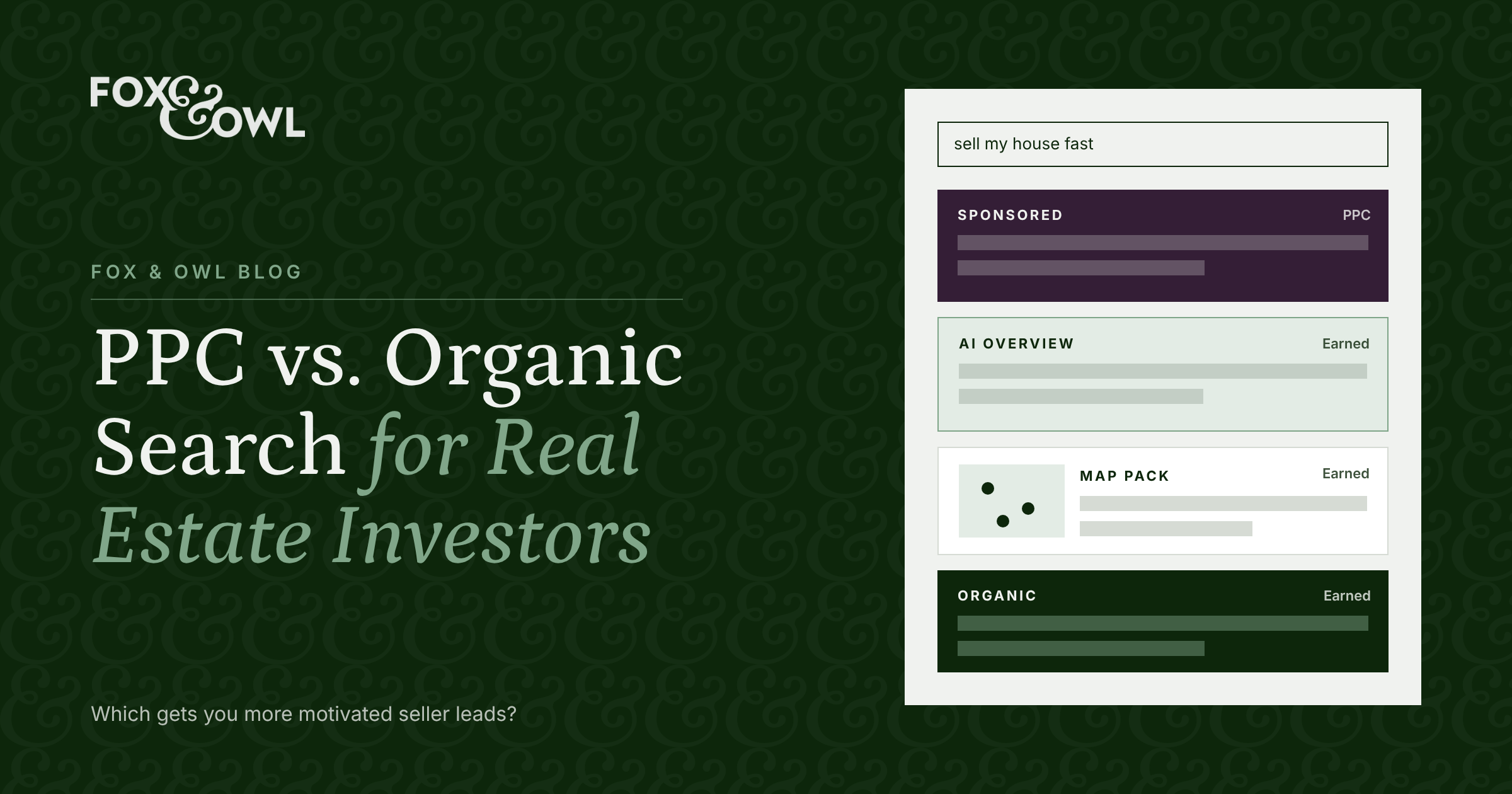

When it comes to getting found online, businesses have two primary options: Google Ads (Pay-Per-Click advertising or PPC) and Search Engine Optimization (SEO). Both can drive traffic to your website, but they work in entirely different ways and deliver results on different timelines. How can you decide whether Google Ads vs SEO is best for your business?
At Fox and Owl Marketing, we’ve helped businesses navigate this Google Ads vs SEO decision, and we’ve seen firsthand how the right strategy (or combination of strategies) can transform a company’s online presence. Understanding the key differences between these approaches will help you make the right investment for your business goals and budget.
What Is Google Ads (PPC)?
Google Ads, formerly known as Google AdWords, is Google’s paid advertising platform. When you run Google Ads, you’re paying for prime real estate at the top of search results.
Here’s how it works: You bid on keywords related to your business, create ads, and pay each time someone clicks on your ad (hence “pay-per-click” or PPC). Your ads appear above the organic search results, marked with a small “Ad” label.
Example: If you’re a plumber in Denver and someone searches “emergency plumber Denver,” your Google Ad could appear at the very top of the results page. We recently helped a local HVAC company achieve this exact result, and they saw a 300% increase in emergency service calls within the first month of launching their Google Ads campaign.

What Is SEO?
Search Engine Optimization (SEO) is the practice of optimizing your website and online presence to rank higher in organic (unpaid) search results.
When done correctly, SEO helps your website appear naturally when people search for terms related to your business.
SEO involves optimizing your website’s content, technical structure, and building authority through backlinks and other factors that Google considers when ranking websites.
Do you want to learn about Why Local SEO for Small Businesses is so important or What to do if your SEO Rankings are Fluctuating? We have written tons of blog posts like these for you to learn more about SEO, PPC, and other online marketing services. Read more of our blogs here.
Example: Using the same plumber scenario, good SEO would help your plumbing company’s website show up in the organic results when someone searches “emergency plumber Denver” – without paying for each click.
One of our clients, Paul Myers with Myers House Buyers, now gets mentioned more than twice as much as Zillow across major AI platforms thanks to our strategic SEO work – proving that with the right approach, local businesses can outrank national giants.
Key Differences Between Google Ads vs SEO
Speed of Results
Google Ads: Nearly instant results. Once your campaign is approved and live, your ads can start appearing within hours. At Fox and Owl Marketing, we’ve had clients see their first leads within 24 hours of launching a campaign.
SEO: Long-term strategy. Meaningful results typically take 3-6 months, with full results often taking 6-12 months or longer. However, our systematic approach and proprietary AI tracking tools help us accelerate this timeline for many clients.
Cost Structure
Google Ads: You pay for every click, regardless of whether it converts. Costs can range from $1-50+ per click depending on your industry and competition.
SEO: Upfront investment in optimization work, but no ongoing cost per visitor. Once you rank, organic traffic is essentially “free.”
Sustainability
Google Ads: Traffic stops immediately when you stop paying. Your visibility is directly tied to your advertising budget.
SEO: Results compound over time. Well-optimized content can drive traffic for years with proper maintenance.
Click-Through Rates
Google Ads: Typically see 2-5% click-through rates, but users know they’re clicking on ads.
SEO: Organic results often have higher click-through rates (especially top 3 positions) because users trust organic results more.
Control and Flexibility
Google Ads: Complete control over ad copy, targeting, budget, and timing. You can test and adjust campaigns in real-time.
SEO: Less direct control. You optimize for search engines, but Google ultimately decides your rankings.
When to Choose Google Ads
Google Ads are ideal when you need:
Immediate results for new product launches, seasonal promotions, or urgent business needs
Precise targeting for specific demographics, locations, or device types
Quick testing of keywords and markets before investing in long-term SEO
Budget certainty with controlled daily spending limits
Competitive industries where SEO results would take too long to achieve
When to Choose SEO
SEO is the better choice when you want:
Long-term growth and sustainable organic traffic
Cost-effective traffic over time (lower cost per acquisition)
Brand authority and credibility that comes with ranking organically
Comprehensive online presence that works 24/7 without ongoing ad spend
Better ROI over the long term for most businesses
The Best Approach: Using Both Together
The most successful businesses don’t choose between Google Ads and SEO – they use both strategically. This is exactly what we recommend to our clients at Fox and Owl Marketing, and here’s why it works so well:
Short-term: Use Google Ads to drive immediate traffic and revenue while your SEO efforts are building momentum.
Long-term: Invest in SEO to reduce dependence on paid advertising and achieve better ROI over time.
Data sharing: Use insights from Google Ads to inform your SEO keyword strategy, and use SEO research to improve your ad targeting. Our integrated approach means your Google Ads data directly improves your SEO performance and vice versa.
Coverage: Dominate search results by appearing in both paid and organic listings for your most important keywords. We call this “search real estate domination,” and our clients consistently outperform competitors who only focus on one strategy.
Making the Right Choice for Your Business
Consider your business situation:
New businesses often benefit from starting with Google Ads for immediate visibility while building their SEO foundation. We typically recommend a 60/40 split initially – 60% of budget on Google Ads for immediate results, 40% on SEO foundation building.
Established businesses should typically prioritize SEO for long-term growth while using Google Ads strategically for specific campaigns. Our established clients often see the best ROI with a 70/30 split favoring SEO.
Service-based businesses with local customers often see great results from both local SEO and geo-targeted Google Ads. We’ve helped dozens of service companies dominate their local markets using this dual approach.
E-commerce businesses frequently use Google Ads for product promotions while relying on SEO for category and informational content. Our e-commerce clients typically see 40-60% of their revenue come from organic search within 12 months.

The Bottom Line
Google Ads and SEO serve different purposes in your digital marketing strategy. Google Ads provide immediate, controllable results at a direct cost, while SEO builds long-term, sustainable organic visibility.
At Fox and Owl Marketing, we’ve seen businesses transform their growth by understanding these differences and implementing the right strategy for their situation. Whether you need immediate results from Google Ads, long-term growth from SEO, or the powerful combination of both, the key is having an experienced team that understands how to make each strategy work effectively.
The best approach depends on your business goals, timeline, and budget. Most successful businesses eventually use both, starting with the strategy that best matches their immediate needs and gradually building a comprehensive search marketing approach.
Remember: the goal isn’t to choose between Google Ads and SEO – it’s to understand how each can help you achieve your business objectives and create a strategy that maximizes your online visibility and ROI. That’s precisely what we help our clients do every day.
Ready to develop a search marketing strategy that’s right for your business? At Fox and Owl Marketing, we specialize in both Google Ads and SEO, and we can help you determine the best approach for your goals and budget. With our proprietary AI tracking tools and integrated approach, we’ll help you dominate your market online. Contact us today for a free consultation.